
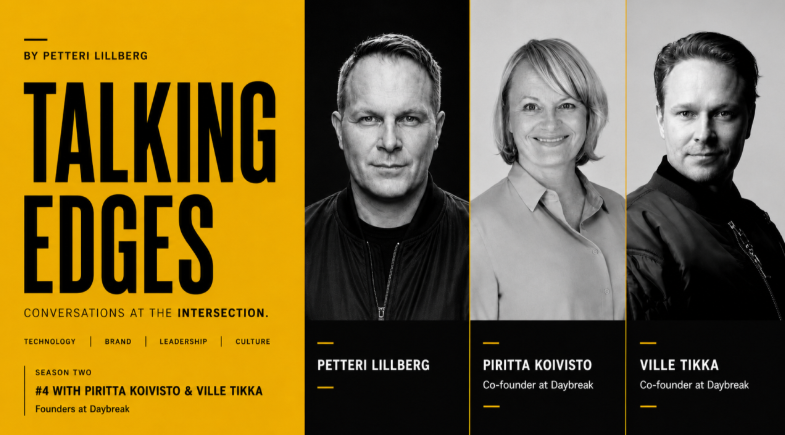
#TalkingEdges is an interview series by Petteri Lillberg, bringing together leaders who are redrawing the edges of their markets and organisations, and becoming the person they are while doing it.
This is a #TalkingEdges conversation with two people I am very lucky to call my friends, Piritta Koivisto and Ville Tikka, the founders of the brand-new strategy company Daybreak. I have known Piritta for 20+ years (since our shared days at Dynamo, a legendary alma mater for some of the leading lights in the current Finnish creative landscape), and Ville since the remote-meeting rush of early 2020.
It's funny how one uncovers new and surprising things about people you know once you apply the #TalkingEdges lense. Enjoy this very inspiring conversation, our first ever with two people.
Blending Day & Night
"Day language is hard data, analytics, and business logic. Night language is humanities, emotion, and art-based sensemaking. Strategy fails when we pretend they belong in separate rooms."
Ask Piritta and Ville what their edge is, and you won't get a neat corporate one-liner. Well, you do get a line but of many connecting lanes where logic vs creativity, machine vs humans lose the vs and are replaced by “and” and “together”. Treating all of them as separate entities has long stopped producing the results modern organizations need.
Strategy isn´t dead.
It´s probably more needed than ever. What we need is a new toolbox.
We have realized at #TalkingEdges that the people who do new stuff, rarely stay inside a box. They are very much unboxable. Piritta left a partner position at a top ad agency to co-found a customer insight firm when it was "the least media-sexy move in the business." The agency was a success breathing some fresh air into a somewhat dusty category at the time, and provided her with an exit. Ville in turn has taken an unorthodox leap into the cultural sector and back to explore the new business models of art, breaking the mold of a conventional CV.
Ideas Are the Easy Part. Ruthless execution isn´t.
"Producing ideas isn't difficult in itself, but to make them happen, you need enough structure."
In our conversation, Piritta makes a point that ideation is no longer a scarce resource. The real scarcity hits after the idea. She talks about the need to ruthlessly execute, and having just the right amount of structure:
The Structure: Ruthless execution requires knowing the micro-details without letting those details derail the vision.
The Human Element: Executing a plan fails without deep empathy for the people carrying it out. Authentic leadership is rooted in service.
But one should take note. Ruthless execution is a lot more about the people than the process. As Ville says it,
"We only exist for other people."
The Tyranny of the Business Case
The business case is the lingua franca of boardrooms. If you want to get stuff done, it´s a format you need to master.
But our conversation questioned why we have grown to rely so heavily on a format that often actively favours incremental thinking over breakthrough innovation.
The business case and its rigid format systematically filters out emotion, surprise, and the "WOW." Daybreak’s answer is a business case built for conviction and feeling, not just defensibility. The goal isn't to make executives agree the numbers add up; it's to make someone in the room desperately want the future being described.
Sustainability & "The Irresistible Urge"
The intersection of sustainability and business impact remains the last great hope for corporate enterprise. In our discussion, we agreed that the trap lies in how responsible language sits far outside standard commercial narratives.
The unlock is total integration: framing sustainability not as a compliance track, but as the most commercially attractive solution available. As Ville pointed out, referencing the Danish Design Centre, we must create "The Irresistible Urge" - the undeniable emotional pull of the transition ahead.
Leading by Being Led
Very few people are born leaders; real leadership is learned from - in the lack of a better word – being a follower first:
Beyond Expertise: Execution in strategy or operations gets you promoted, but leading requires an intense, authentic interest in energizing people.
Leading Without Title: Finding leadership within any role by acting as a coach rather than an authority.
Decisiveness: While a leader can fear many things, making decisions cannot be one of them. The puck stops with you.
Equipped for the Future
Toward the end of our conversation, we turned outward to what it means to work at the edge of an unprecedented shift. Daybreak’s mission isn't to predict what comes next in an unstable world, but to build the capacity to move inside "not-knowing”. Their closing sentiment doubles as a near-mission statement:
"We need to design an entirely new strategy toolkit. For work and how we create value.”
The original interview can be read here: